Showing posts with label anti-semitism. Show all posts

Thursday, December 31, 2020

“2021 – A Decisive Year For Europe” (Linkedin)

 My new article on Linkedin “2021 – A Decisive Year for Europe

2021 is going to be a decisive year for Europe. The Old Continent has become a cesspool of divisiveness among countries, factions, movements, and peoples. The UK, Germany, France, the Balkans, Italy, Spain, everything is so divided and splintered that unless Europeans start thinking of themselves as one entity very soon, they will suffer terribly. It will certainly not be easy, but a pan European identity is their only way out of anguish.

Europe is in many ways the cradle of human development. As such, the world will look at it and learn, and Europe should show the world what the future of the world can be like. It must show that despite all the many colors, races, nationalities, and their war-ridden history, they can rise above it and build themselves as one family, truly as one family. Otherwise, they will simply consume one another. If they do not unite, I see no future for them.

Besides their internal frictions, China, Russia, and the US will vie over control in Europe, and nothing will be left of “the Old Lady.” Even Africa will join the “party,” as is already happening with the migration of refugees, but in other ways, as well.

When you look at the world map, it’s interesting to see the unique role that each place has in bringing the world to a better place. The US is an example of a nation divided into myriad factions that are still one nation. Europe is an example of many nations that must function as one nation. Each must provide an example of unity above the differences that the world can follow. If either of them fails to carry out their role, they will suffer. I can’t say who will suffer more if they do not execute their required union, but both will certainly agonize.

Israel, too, has its unique role. In fact, Israel’s role is perhaps the most important in the process of unifying the world. Israel must provide the philosophy, the theory, the ideological infrastructure for unity: where it comes from, why unity is essential, and by which rules and regulations we are to arrange it.

The current European Union will not achieve these goals. In fact, I am all for dismantling it, and I’m happy that the UK left it. The current EU was not built in order to unite Europe. It was established in order to bolster banks, industrialists, and billionaires, but not to unite Europe. One could drive from one end of Europe to the other before the establishment of the EU, so there is no benefit in terms of open borders. The regular person does not gain anything from living in a so-called united Europe.

As I said in the beginning, a European union should be a union of the hearts, where they feel that they are in deep connection. And the more different they are, the more tightly they will unite, according to their efforts. The ones who are the farthest now will be the closest once they unite.

This union must be completely unrelated to the existing institutions of the EU. It must be a separate entity that functions whether or not the current EU survives the approaching upheavals. This union of hearts is the union they were searching for over the past thirty years or so since they established the EU.

And as for Israel and the ideology that Israel is required to provide, the level of hatred that Europeans will harbor toward Israel depends on the level of their hatred for connection. If Israel offers a way to connect—which isn’t the current situation, but presumably—and the Europeans shun it because they do not want to connect, then they will have no choice but to take some more beating from other countries or from nature until they yield and become receptive to the notion of connection.

And speaking of antisemitism, we think it is impervious to reason, and perhaps this is so, as are all hatreds. However, antisemitism is not impervious to a model of unity coming out of Israel. Even Henry Ford, whose antisemitic ideology Hitler admired, wrote in his rabid composition The International Jew—the World’s Foremost Problem, “The emergence of the Jewish Question is a part of the culmination of destiny that has come upon us, not for harm but for good. …The justification of a discussion of the Jewish Question is the good for the Jews, and the greatest present obstacle to that good is the Jews themselves. The time is here when they shall see it.”

In other words, antisemitism is not necessarily a fact of life, but something that Israel can overcome by carrying out its role, and by the nations accepting Israel’s contribution—the ideology of unity. The future of Europe hangs in the balance; if Europeans overcome their divisions soon, they will triumph. If not, they will lose bitterly. Israel, for its part, must do its duty in the healing by providing the ideology of unity above differences and by setting an example.


Friday, December 25, 2020

“On Jewish Unity And Antisemitism – Israel’s Golden Era” (Times Of Israel)


Michael Laitman, On The Times of Israel: “On Jewish Unity and Antisemitism – Israel’s Golden Era

Following their liberation from slavery in Babylon after King Cyrus had sent them free with “silver and gold, with goods and cattle, together with a freewill offering for the house of God which is in Jerusalem” (Ezra 1:4), the expats, or more accurately, two of the twelve tribes of Israel, returned to the land of Israel and to Jerusalem and built the Second Temple. The history of our people is strewn with agony. But the period between the Cyrus Declaration, in 539 BCE, and the beginning of the Hasmonean revolt, in 166 BCE, was relatively a quiet one and marked by a great achievement: being a role model of unity for the nations, even if briefly.

It isn’t that there were no squabbles among the Jews at that time. Since we were called upon to rebuild the Temple, there was much to argue about. But one way or the other, the Temple was built and quiet was restored. In fact, some of those years might even be regarded as the people of Israel’s golden era.

In terms of material life, not much is known about the lives of the people of Israel in the land of Israel during the third and fourth centuries BCE. In his book A History of the Jews, renowned historian Paul Johnson writes about that peaceful time in our history, when there was nothing to report: “The years 400-200 BC are the lost centuries of Jewish history. There were no great events or calamities they chose to record. Perhaps they were happy,” he concludes.

However, on the social and spiritual levels, much was happening. Three times a year the Jews would march up to Jerusalem to celebrate the festivals of pilgrimage: Passover, Shavuot (Feast of Weeks), and Sukkot. During each pilgrimage, the sight was spectacular. The pilgrimages were intended primarily for gathering and uniting the hearts of the members of the nation. In his book The Antiquities of the Jews, Flavius Josephus writes that the pilgrims would make “acquaintance … maintained by conversing together and by seeing and talking with one another, and so renewing the recollections of this union.”

Once they entered Jerusalem, the pilgrims were greeted with open arms. The townsfolk let them into their homes and treated them as family, and there was always room for everyone.

The Mishnah relishes this rare camaraderie: “All the craftsmen in Jerusalem would stand before them and ask about their well-being: ‘Our brothers, men of so and so place, have you come in peace?’ and the flute would play before them until they arrived at Temple Mount.” Additionally, every material need of every person who came to Jerusalem was met in full. “One did not say to one’s friend, ‘I could not find an oven on which to roast offerings in Jerusalem’ … or ‘I could not find a bed to sleep in, in Jerusalem,’” writes the book Avot de Rabbi Natan.

Even better, the unity and warmth among the Hebrews projected outward and became a role-model for the neighboring nations. The philosopher Philo of Alexandria portrayed the pilgrimage as a festival: “Thousands of people from thousands of cities—some by land and some by sea, from the east and from the west, from the north and from the south—would come each festival to the Temple as if to a common shelter, a safe haven protected from the storms of life. …With hearts filled with good hopes, they would take this vital vacation with sanctity and with glory to God. Also, they made friendships with people they had not met before, and in the merging of the hearts … they would find the ultimate proof of unity.”

Philo was not the only one who admired what he saw. Those festivals of bonding served as a way for Israel to be—for the first time since they were given that vocation—“a light unto nations.” The book Sifrey Devarim details how gentiles would “go up to Jerusalem and see Israel … and say, ‘It is becoming to cling only to this nation.’”

Some three centuries later, The Book of Zohar (Aharei Mot) described succinctly and clearly the process that Israel went through: “‘Behold, how good and how pleasant it is for brothers to also sit together.’ These are the friends as they sit together and are not separated from each other. At first, they seem like people at war, wishing to kill one another … then they return to being in brotherly love. …And you, the friends who are here, as you were in fondness and love before, henceforth you will also not part from one another … and by your merit, there will be peace in the world.” Indeed, being “a light unto nations” could not have been more evident than at that time.

In fact, the renown of the Jews at that time went so far that it initiated the proliferation of their law outside of Israel. By the mid-240s BCE, the rumor of Israel’s wisdom had reached far and wide. Ptolemy II, king of Egypt, had a passion for books. This led him to aspire to possess all the books in the world, especially those containing wisdom. According to Flavius, Ptolemy told Demetrius, his librarian, that he “had been informed that there were many books of laws among the Jews worthy of inquiring, and worthy of the king’s library.” Not only did Ptolemy not have these books, but even if he did, he would not be able to read them since they were “written in characters and in a dialect of their own [Hebrew], [which] will cause no small pains to get them translated into the Greek tongue,” which Ptolemy spoke.

But Ptolemy did not give up. He wrote to the High Priest in Jerusalem, Eleazar, and asked that he would send him men who could translate the Jewish books to Greek. Seventy men were sent down to Egypt following Ptolemy’s request. But the king did not send them off to work right away. First, he wanted to learn their wisdom and absorb whatever knowledge he could from them. Therefore, “he asked every one of them a philosophical question,” which were “rather political questions and answers, tending to the good … government of mankind,” writes Flavius. For twelve straight days, the Hebrew sages sat before the king of Egypt and taught him governance according to their laws. Along with Ptolemy sat his philosopher, Menedemus, who was in awe at how “such a force of beauty was discovered in these men’s words.” This, indeed, was Israel’s heyday.

Finally, “When they had explained all the problems that had been proposed by the king about every point, he was well-pleased with their answers.” Ptolemy said that “He had gained very great advantages by their coming, for that he had received this profit from them, that he had learned how he ought to rule his subjects.”

Once Ptolemy was satisfied with the answers they had given him, he sent them off to an isolated location where they had peace and quiet and could focus on the translation. When they completed their task, writes Flavius, they handed over to the king the complete translation of the Pentateuch. Ptolemy was “delighted with hearing the Laws read to him, and was astonished at the deep meaning and wisdom of the legislator.”

Historian Paul Johnson, whom we mentioned earlier, wrote about the Jews in antiquity that “At a very early stage in their collective existence they believed they had detected a divine scheme for the human race, of which their own society was to be a pilot.” Perhaps during the third century BCE, our forefathers succeeded in that task. However, as we know from history, our brotherhood did not last, and less than a century after those wondrous events took place, Israel were engulfed in a bloody civil war. This will be the topic of the next essay.

(Article No. 6 in a series – previous article)

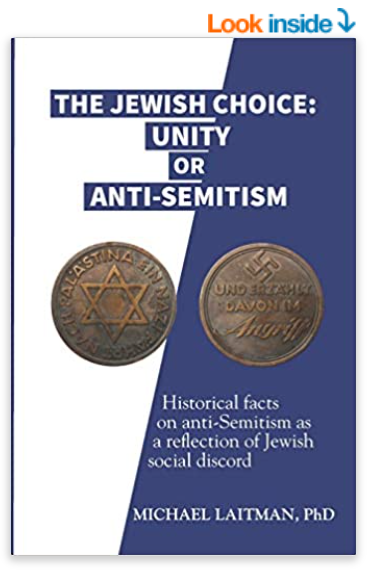
For much more on this topic, please see my latest publication, The Jewish Choice: Unity or Anti-Semitism: Historical facts on anti-Semitism as a reflection of Jewish social discord

Thursday, December 24, 2020

“On Jewish Unity And Antisemitism – Emerging From Exile And Starting Anew” (Times Of Israel)


Michael Laitman, On The Times of Israel: “On Jewish Unity and Antisemitism – Emerging from Exile and Starting Anew

(Article No. 5 in a series) In the previous article, we discussed the rise and fall of the First Temple due to bloodshed and sins among the kings of Israel. When Israel were exiled, they were sent to Babylon, from which Abraham had previously come. There, in Babylon, they dispersed and assimilated until once again, a great hater of Jews arose and sought to destroy them: the arch-antisemite known as Wicked Haman.

Haman said to King Ahasuerus that the Jews were separated: “There is a certain people scattered and dispersed among the peoples in all the provinces of your kingdom” (Esther 3:8). However, their physical dispersion was not what instigated Haman’s hatred; it was their disunity. The 17th century commentary on the Torah, Kli Yakar, states it very clearly: “‘a certain people scattered and dispersed’ means that they were scattered and dispersed from one another.” Likewise, the prominent interpretation of Jewish law, Yalkut Yosef, takes “separated” to mean that “there was separation of hearts among them.” So, as it happened with Pharaoh, and as it happened with Nebuchadnezzar, separation among the people of Israel leads to emergence of enemies who wish to destroy them. Haman was just another link in the chain, albeit quite a vicious one.

To get what he wanted, Haman told King Ahasuerus that the Jews “do not observe the king’s laws” (Esther 3:8). Yet, even though the king permitted him to eliminate the Jews, each year on Purim, we celebrate the miracle of our survival because at the very last minute, Mordechai united all the Jews. “‘Go gather all the Jews,’ meaning tell them words of blandishment,” writes Haim Yosef David Azulai (the CHIDA) in the book Pnei David, “so they will all be in one unity. Go gather as one, the hearts of all the Jews.” This telling 18th century description demonstrates the desperation of Esther and Mordechai at the prospect of seeing their entire fold obliterated, as was Haman’s intent. Their last resort was unity. When the Jews united, they saved themselves and facilitated the beginning of the return from Babylon.

But unlike Egypt, when the Jews had to flee in the dead of night, this time, they left not only with the king’s blessing, but with his full moral, financial, and spiritual support: As soon as Cyrus came to power, he felt that God had ordered him to send the Jews back to their land and rebuild the Temple. He sensed he had been commanded to help them in their task. He gave the famous Cyrus Declaration which stated, “Every [Jewish] survivor, at whatever place he may live, let the men of that place support him with silver and gold, with goods and cattle, together with a freewill offering for the house of God which is in Jerusalem” (Ezra 1:4). After his order was carried out, “King Cyrus brought out the utensils of the house of the Lord, which Nebuchadnezzar had carried away [plundered] from Jerusalem and put in the house of his gods” (Ezra 1:7).

The Cyrus Declaration marked the official end of the exile in Babylon and the beginning of the era of the Second Temple, though the Temple itself had not yet been built. During that period, the Jews achieved great heights, but eventually declined to two civil wars, the last of which was so bloody and brutal that its wounds have yet to heal.

The next article in the series will tell the story of the “golden era” in the history of the Jews in the land of Israel, when the nations of the world wanted to learn from them how to conduct their social lives.

For much more on this topic, please see my latest publication, The Jewish Choice: Unity or Anti-Semitism: Historical facts on anti-Semitism as a reflection of Jewish social discord.

Monday, December 21, 2020

“The EU Court Of Justice Spelled It Out For Jews: Leave Europe!” (Times Of Israel)


Michael Laitman, On The Times of Israel: “The EU Court of Justice Spelled It Out for Jews: Leave Europe!

Last week, the European Union Court of Justice upheld a ban on kosher and hallal slaughter in Belgium, The Jerusalem Post reported. While Brooke Goldstein, who helped with the legal challenge, called it a “shameful ruling,” and warned that “the religious freedom of millions of Europeans has been put in jeopardy,” Israel’s Foreign Ministry seems to have “read the lips” of the EU court more clearly, stating that the decision “signals to Jewish communities that they are not wanted in Europe.”

This would not be the first time that European countries have used kosher slaughter bans as a means to deter Jews from immigrating to them or as a way to push them out. According to The Jerusalem Post, President of the Conference of European Rabbis, Rabbi Pinchas Goldschmidt, said bans on religious slaughter have been an attempt to control a country’s population and can be traced back to the 1800s, when Switzerland attempted to stop Jews fleeing pogroms from entering their country, and can also be traced to Nazi Germany. According to Goldschmidt, “Europe needs to reflect on the type of continent it wants to be.”

In my view, Europe has already reflected on this question and decided that it wants to be Jew-free. Several countries, such as Denmark, Iceland, and Finland, are already mulling a ban on circumcision, and the recent EU Court of Justice ruling on kosher food is certain to encourage other countries to follow in Belgium’s footsteps.

Antisemitism in Europe is deeply rooted. Jews have been beaten, banished, and burned all over the continent for as long as they have lived there. The fact that technology has made life easier has not changed people’s hearts. If we need proof, we need only look to the events of the 1940s, when the most civilized country in Europe, and possibly the world, and the second most technologically advanced (after the United States), resolved to eliminate the Jews.

If anything surprises me about this decision, it is the reaction of Jewish leaders. If they are genuinely surprised by this decision, it is very discouraging.

In my view, within a year or two, many other countries will join Belgium’s decision and will take action to deter Jews from living in them. It will happen all over Europe. Another possible scenario, which is even more radical than bans in specific countries, is that the EU court will resolve to ban Jewish laws all over Europe.

There is a Russian antisemitic joke that every Jew who leaves Moscow gets a “Liberator of Moscow” medal. I think Europeans, too, will be happy to award Jews medals for moving out of their cities and countries. It is not unlike what Hitler did when he sent out 900 Jews from Germany on the luxurious ocean-liner SS St. Louis en route to Cuba and from there to the US, but neither Cuba nor the US would have them so they were forced back to Europe, where many of them perished in the Holocaust.

I truly wish we Jews were smarter. It’s as if our nation is stupefied by complacency, and an opaque cloud of folly comes over us in good times and doesn’t let us see how perilous matters have become. We think that as long as we can do business in Europe, and as long as we have some friends who aren’t Jewish, we’re safe. This is not the case and it is no longer safe. In Europe, the good times are over, and in the US, they’re quickly ending, too.

Friday, December 4, 2020

“On Jewish Unity And Anti-Semitism – The Rise And Fall Of The First Temple” (Times Of Israel)


Michael Laitman, On The Times of Israel: “On Jewish Unity and Anti-Semitism – The Rise and Fall of the First Temple

(Article No. 4 in a series) In the previous article, we described Israel’s formation into a nation and how they were given the task to be “a light unto nations” by becoming a model of unity above differences. This article is the first to explore Israel’s attempts to maintain their unity after establishing nationhood, their failure to do so, and the consequences of that failure.

Once they became a nation by vowing to unite “as one man with one heart,” the people of Israel set out to Canaan. Along the way, they had many internal struggles, as well as struggles with external foes. Their growing egos kept challenging them in new ways and they had to find new tactics to overcome them. However, as it is written in The Book of Zohar (BeShalach, item 252), “Anyone who wages a war in the Torah is rewarded with increased peace in the end.” In other words, the wars that the people of Israel fought were over keeping the vow of complete unity.

Still, soon after Israel conquered Canaan and made it the Land of Israel, the disputes grew so fierce that the nation divided into two kingdoms: the Northern Kingdom (Israel) and the Southern Kingdom (Judea). The Northern Kingdom was weaker spiritually and its people quickly abandoned their commitment to unity. The Talmud (Yoma 9b) describes the leaders of the Kingdom of Israel’s malevolence toward each other very poignantly: “Rabbi Elazar said, ‘Those people, who eat and drink with one another, stab each other with the swords in their tongues.’ Thus, even though they were close to one another, they were filled with hatred for each other.” With such relationships, it did not take long for the Kingdom of Israel to dissolve into obscurity to this day.

Meanwhile, in Judea, our forefathers did not behave much better than their now vanished relatives. The 1st century Jewish-turned-Roman historian Titus Flavius Josephus details the misconduct of our forefathers. While the list of misdeeds is far too long for the scope of this article-series, it is important to realize how brutal was the hatred of the Judeans for their brethren. In The Antiquities of the Jews (Book IX, Chap. 5), Josephus offers some gruesome details on the foul manner with which the kings of Israel treated one another. When writing about the anointing of King Jehoram, who ruled merely seventy years after King Solomon, who taught that “Hate stirs strife, and love will cover all crimes” (Prov. 10:12), Josephus says that “As soon as [Jehoram] had taken the government upon him, he betook himself to the slaughter of his brethren and his father’s friends.”

King after king, the rulers of Judea murdered one another in an astonishing display of depravity. Josephus writes that King Manasseh “barbarously slew all the righteous men that were among the Hebrews. Nor would he spare the prophets, for he every day slew some of them, till Jerusalem was overflown with blood” (Book X, Chap. 3).

Clearly, this demeanor was not sustainable, and when the Babylonian king Nebuchadnezzar II invaded the land of Israel, Judea was far too weak to defend against him. Although we are taught that Nebuchadnezzar conquered Judea and destroyed the First Temple, it is important to note that our sages and all the ancient texts do not attribute the fall of the Temple to Nebuchadnezzar, but to our own vices against each other.

Incidentally, this pattern of pointing the finger to our own sins as the cause of our misfortunes, rather than to external foes, was the predominant mindset in antiquity. This changed only in recent centuries, when our arrogance and self-righteousness grew to such levels that we could not see any fault in ourselves and blamed all our troubles on others, despite millennia of our own sages telling and writing otherwise.

The exile in the Babylonian captivity was short but eventful. We will cover the events that led to the threat of destruction and eventual liberation through the Cyrus Declaration in the next article, where once again, we will see that unity brings freedom and happiness, and separation brings misery to our people.

For much more on this topic, please see my latest publication, The Jewish Choice: Unity or Anti-Semitism: Historical facts on anti-Semitism as a reflection of Jewish social discord.
[274887]

“All Eyes Will Turn To The Jews” (Times Of Israel)


Michael Laitman, On The Times of Israel: “All Eyes Will Turn to the Jews

Over the past week, two antisemitic incidents caught the attention of Jewish media in the US. Algemeiner reported that in New Jersey, “the carcass of a dead pig was left on the doorstep of a rabbi’s home in the town of Lakewood,” and Tablet Magazine released an intriguing story about a closed Facebook group of liberal women who expel anyone who expresses any support or understanding for Israel. Tablet quoted a Korean American Jewish woman named Skylar Cutler who said, “What I saw and experienced in that group was Jew-hatred cloaked in the veil of social justice. I had to speak out.”

The vast majority of American Jews were delighted that Biden was declared the winner of the 2020 presidential election, and I have no doubt they cannot wait for him to take office. I, too, think it will be good for them, but for a different reason: They will have a very sobering experience. With Biden as president, they will have no one to blame. After all, they picked him themselves and did everything they could, and beyond, to get him elected. But the antisemitism that will come from the Left, from the liberals and progressives, will show them very clearly that antisemitism has nothing to do with the identity of the president.

The majority of American Jews espouse liberal and progressive values. When antisemitism hits them, as it did in that Facebook group, they will understand that they are not hated for supporting Israel or for being white and privileged, but for being Jewish. As that Korean American Jew said, it is “Jew-hatred cloaked in the veil of social justice.” When it comes to Jews, there is nothing progressive about the views of “Progressives,” and American Jewry is about to realize it, if it hasn’t already.

When the final outcome of the elections is declared, both sides will turn their anger to the Jews. The liberals and progressives already harbor deep anti-Jewish feelings, and conservatives, who aren’t inherently anti-Jewish, have been given far too many reasons in this campaign to come to the conclusion that all their troubles come from the Jews.

Currently, Left and Right cannot unite in America. But when both sides come to think that all their troubles come from the Jews, they’ll find the common grounds they need. Just as we saw fascists and Muslims demonstrating in concert against Israel in Europe, we will see Liberals and Progressives, White Supremacists and Black Americans finding new unity in their hatred for the Jews.

Then, when American Jews find that all this is eerily similar to what happened in Europe less than a century ago, it may well be too late.
[274891]

Monday, November 23, 2020

“Jewish Unity & Antisemitism: Moses & The Establishment Of The People Of Israel” (Times Of Israel)


The Times of Israel published my new article “Jewish Unity & Antisemitism: Moses & the Establishment of the People of Israel

(Article No. 3 in a series) In the previous article, we described Israel’s time in Egypt, how they prospered while they were united under Joseph’s leadership, and how they assimilated after his passing, which then turned the Egyptians against them. In this article, we will explore Moses’ efforts to reunite the tormented and enslaved people and thereby redeem them from their oppressors and bring them out of Egypt. We will also show that once they united and were redeemed, they were tasked with being “a light unto nations,” namely to pass on their unity to the rest of the world.

Despite their worsening situation in Egypt, Israel did not unite until the arrival of Moses. When he arrived, he began to reunite Israel until, eventually, they were able to escape from Pharaoh’s rule.

Once out of Egypt, at the foot of Mt. Sinai, the people of Israel solidified their unity to the point that they became as one. This is why the great 11th century commentator RASHI described them as being “as one man with one heart.” That level of unity was the requirement for the aggregate of strangers who subscribed to Abraham’s message to be “officially” declared a nation. There, at the foot of the mountain, was the birth of the nation of Israel. The example of disunity and enslavement vs. unity and redemption that the Hebrews had experienced in Egypt was to be a lesson for them to maintain their unity no matter how intense their egoism grows. As we will see throughout this series, the linkage between disunity and adversity has not been broken since. Regrettably, neither has the lesson been learned.

When Moses united the people of Israel, he did not intend to unite Israel only for their own sake. Just as Abraham wanted to unite all the Babylonians but had to do with those who followed him, Moses wanted to help the whole world find unity, not just the Israelites.

Accommodating Moses’ wish to spread the ideology of unity to all of humanity, immediately after the people of Israel were declared a nation, they were tasked with being “a light unto nations” (Isaiah 42:5, Isaiah 49:6), namely to spread this unity. In The Commentary of Ramchal on the Torah, the great 18th century kabbalist wrote, “Moses wished to complete the correction of the world at that time. This is why he took the mixed multitude, as he thought that thus would be the correction of the world … However, he did not succeed because of the corruptions that occurred along the way.”

Similar to Ramchal, in the 19th century, Isaac Hever Wildman wrote in his book Beit Olamim, “That was Moses’ prayer and blessing to the generation of the desert, that they would be the beginning of the correction of the world.”

Even more astounding words regarding the purpose of establishing the people of Israel were written in the book Maor VaShemesh: “‘That He may establish you today as His people’ means that by that you will have revival, you will be saved from all calamities. Afterward He said to them, ‘Now not with you alone am I making this covenant,’ meaning that being saved from any harm by bonding was not promised only to Moses’ generation. Rather, ‘But with those who stand here with us today … and with those who are not with us here today,’ meaning that all future generations have been promised it—to pass through all the bludgeons of the covenant and that they will not be harmed, through the unity and bonding that will be among them.”

We, therefore, see that the level of unity in Israel, the fate of the people, and the fate of the world have been linked from the very inception of the nation. That unbroken link is at the root of all our troubles, as we will see through the rest of this series.

The next article will look into the events that led to the split within the people of Israel between the Kingdom of Israel, the Kingdom of Judah, and the corruption that led to the ruin of the First Temple.

For much more on this topic, please see my latest publication, The Jewish Choice: Unity or Anti-Semitism: Historical facts on anti-Semitism as a reflection of Jewish social discord.

Saturday, November 21, 2020

“The Pandemic Antisemites Call Israel” (Newsmax)

 My article in Newsmax: “The Pandemic Antisemites Call Israel

People react to what hurts them the most and antisemites are no exception. A global response to the coronavirus pandemic, which continues to wreak havoc with more than 50 million cases worldwide, apparently is not the priority for the U.N.’s World Health Organization (WHO).

Instead of assessing a global response to the problem, it spent four valuable hours of its general assembly bashing its annoyance, Israel. A similar dose of hatred has been injected by antisemites who are accusing Jews behind the companies in charge of the new COVID-19 vaccines of trying to control the world and profit from the pandemic.

More than a million people have died from COVID-19 around the planet. After months of the pandemic, the virus continues to spread uncontrollably, lockdowns have been renewed in multiple cities around the world, the global economy crumbles, the education systems operate irregularly and every realm of people’s lives has been impacted. So how is it possible that the main concern of WHO’s member nations was condemning the Jewish nation for the “health conditions in the occupied Palestinian territory, including East Jerusalem and in the occupied Syrian Golan”?

If they were to search for real facts concerning those portrayed as underserved in health care services, they would discover that in fact the alleged victims receive better medical care in Israel than in any Arab country. So, is there any logic behind singling out Israel over and over again? There is none, because antisemitism is an irrational sentiment.

Conspiracy theories and blood libels against Jews are not new, they are just reignited. The fact that the scientific community has worked around the clock to develop a new vaccine against the deadly virus has only fueled antisemitic allegations.

The top medical expert of Moderna, the pharmaceutical company behind just one of the new COVID-19 vaccines, is Dr. Tal Zaks, an Israeli scientist, and Dr. Albert Bourla, a Jew of Greek descent and CEO of Pfizer, which is responsible for another vaccine against the coronavirus. In Greece, a newspaper published a series of articles accusing Dr. Bourla of Nazi-like intentions behind the scientific discovery and of making millions of dollars from the pandemic in coordination with Israel.

The world has a disease: antisemitism, that particularly resurfaces in times of peril. Why is this so? It is because people feel that Jews hold a pivotal quality to solve the world’s troubles. By attacking Jews, they in fact raise the Jewish nation to the pinnacle, holding them both responsible for the problems and, at the same time, acknowledging them as those able and empowered to repair an aching planet.

It is precisely the role of the Jewish nation, founded upon the tenet of “love your neighbor as yourself,” to lead the way to the attainment of unity and toward recovery of the balance in nature that has been lost as a result of our unruly, egoistic and self-centered human relations. Since the times of Abraham, Jews were the first people to identify and understand the laws of nature, the need to live in a society based on mutual responsibility.

As nature tightens humanity’s connection and more hatred surfaces between people, the time is ripe for learning how to realize our increasing connection positively, how to unite above the growing separation. In the last few months, the need for unity has become pronounced. The coronavirus pandemic illustrates the need for mutual responsibility and consideration to restore and maintain good health and growing social divisiveness demonstrates the need for unity.

If we fail to progress to unity above our own differences as a Jewish nation, we will continue evoking hatred upon ourselves and people will increasingly accuse us of being the root of the world’s problems, as we now also see with the coronavirus.

The sooner we realize that our unity will have a positive rippling effect the world over, the sooner we will realize that we are treating antisemitism at its root. By uniting, we fulfill our role in the world of bringing the forces between humanity and nature back to balance.

If we realize our role and initiate unity between us, we will not only see antisemitism diminish, but also, conversely, we can expect love and respect for a Jewish people who radiate a positive unifying example to the world. Then there would be no reason for anyone to hate Jews because people would know how to unite.

And united people do not hate each other or the ones who show the way to their unity as the only cure to humanity’s pains.

“On Jewish Unity And Antisemitism –Article No. 2” (Times Of Israel)


The Times of Israel published my new article “On Jewish Unity and Antisemitism –Article No. 2

In the previous article, we described Abraham’s struggle to spread his revelation that there is only one force in reality, which he called “God,” that that force manifested in two ways—giving and receiving—and everything, in reality, reflected interactions between the two. We also said that Abraham realized that his contemporaries in Babylon, his homeland, were becoming alienated from each other. Abraham wished to counter that alienation with kindness and mercy in order to balance the growing force of reception with appropriate giving. When his efforts were turned down and he was expelled from Babylon, he wandered west to Canaan. Along the way, thousands and tens of thousands—according to Maimonides, Midrash Rabbah, and many other sources—joined him and became “the house of Abraham.” Those people formed the nucleus from which the Israeli nation would later rise. The special thing about them was that they had nothing biological in common but rather the conviction that receiving must be balanced with giving, and they were willing to toil in order to develop the quality of mercy within them.

This article will review Israel’s time in Egypt. By and large, we are taught that Israel’s time in Egypt was a nightmare—that they were enslaved and tormented there until they had no choice but to escape in the dead of night. Yet, this is a very incomplete representation of the picture.

The book of Genesis (from Chapter 47 and into the book of Exodus) tells us that when Israel went into Egypt, Joseph was already Pharaoh’s viceroy and his most trusted man. Pharaoh even gave him his signet to use as he pleased. When Joseph’s family sought shelter in Egypt, Pharaoh gave them the most fertile land in the country, the land of Goshen, in the eastern Delta of the Nile. Joseph placed his family members in key positions and they prospered under his protection. As long as they were united under Joseph, things went smoothly for them and they were successful, prosperous, and multiplied.

However, when Joseph died, the Israelites’ unity began to weaken. Consequently, everything changed. “The Israelites began to conceal their Jewishness,” writes Prof. Zvi Shimon of Bar-Ilan University in Israel. “They were immersed in Egyptian culture, enthusiastically attending Egyptian cultural events and adopting their modes of entertainment. Egyptian sports and theater were popular pastimes amongst the new Jewish immigrants.” Little by little, they abandoned their commitment to unity and immersed themselves in self-indulgence and narcissism. That, perhaps, was the first incident of disunity that leads to Jew-hatred, long before the terms had been invented.

Much to the Israelites’ regret, the more they wanted to assimilate in Egypt, the more Pharaoh and all of Egypt turned against them. The Book of Zohar (Shemot) asks, “Why were Israel exiled, and why specifically to Egypt?” The answer that The Zohar gives is that they were exiled to Egypt because the Egyptians “were proud and despised and loathed Israel,” and therefore did not want the Hebrews to mingle with them. Midrash Rabbah (Shemot 1:8) adds a more explicit version of the story, pointing the finger directly at the Jews: “When Joseph died, they broke the covenant and said, ‘Let us be as the Egyptians.’ …Because of it, the Lord turned the love that the Egyptians loved them into hatred.” In other words, Pharaoh and the Egyptians didn’t turn against Israel simply because they were bad people, but because they abandoned the legacy of unity and strove to mingle with Egypt and disunite from one another.

This is why the Torah writes that only after Joseph died, Pharaoh turned against the Hebrews. Once Pharaoh became “antisemitic,” if you will, the Hebrews had no choice but to reunite. This pattern, where Jews shun unity when they are prosperous and are forced into it by the persecution of a local leader would repeat itself from Egypt to this day.

These days, we are seeing the end of the same cycle in America. Jews have been prosperous for several decades, achieved material wealth and power, but have abandoned their unity. Now we are seeing the flipping of the country from appreciation and approval to denunciation, criticism, and eventually hate.

In the next article, we will review Moses’ efforts to reunite the tormented people and thereby redeem them from their oppressors.

For much more on this topic, please see my latest publication, The Jewish Choice: Unity or Anti-Semitism: Historical facts on anti-Semitism as a reflection of Jewish social discord.

Thursday, November 19, 2020

“The Pandemic Anti-Semites Call Israel” (Times Of Israel)


The Times of Israel published my new article “The Pandemic Anti-Semites Call Israel

People react to what hurts them the most and anti-Semites are no exception. A global response to the coronavirus pandemic, which continues to wreak havoc with more than 50 million cases worldwide, apparently is not the priority for the UN’s World Health Organization (WHO). Instead of assessing a global response to the problem, it spent four valuable hours of its general assembly bashing its annoyance, Israel. A similar dose of hatred has been injected by anti-Semites who are accusing Jews behind the companies in charge of the new COVID-19 vaccines of trying to control the world and profit from the pandemic.

More than a million people have died from COVID-19 around the planet. After months of the pandemic, the virus continues to spread uncontrollably, lockdowns have been renewed in multiple cities around the world, the global economy crumbles, the education systems operate irregularly, and every realm of people’s lives has been impacted. So how is it possible that the main concern of WHO’s member nations was condemning the Jewish nation for the “health conditions in the occupied Palestinian territory, including East Jerusalem, and in the occupied Syrian Golan”?

If they were to search for real facts concerning those portrayed as underserved in health care services, they would discover that in fact the alleged victims receive better medical care in Israel than in any Arab country. So, is there any logic behind singling out Israel over and over again? There is none because anti-Semitism is an irrational sentiment.

Conspiracy theories and blood libels against Jews are not new, they are just reignited. The fact that the scientific community has worked around the clock to develop a new vaccine against the deadly virus has only fueled anti-Semitic allegations.

The top medical expert of Moderna, the pharmaceutical company behind just one of the new COVID-19 vaccines, is Dr. Tal Zaks, an Israeli scientist, and Dr. Albert Bourla, a Jew of Greek descent and CEO of Pfizer, which is responsible for another vaccine against the coronavirus. In Greece, a newspaper published a series of articles accusing Dr. Bourla of Nazi-like intentions behind the scientific discovery and of making millions of dollars from the pandemic in coordination with Israel.

The world has a disease: anti-Semitism that particularly resurfaces in times of peril. Why is this so? It is because people feel that Jews hold a pivotal quality to solve the world’s troubles. By attacking Jews, they in fact raise the Jewish nation to the pinnacle, holding them both responsible for the problems and, at the same time, acknowledging them as those able and empowered to repair an aching planet.

It is precisely the role of the Jewish nation, founded upon the tenet of “love your neighbor as yourself,” to lead the way to the attainment of unity and toward recovery of the balance in nature that has been lost as a result of our unruly, egoistic and self-centered human relations. Since the times of Abraham, Jews were the first people to identify and understand the laws of nature, the need to live in a society based on mutual responsibility.

As nature tightens humanity’s connection and more hatred surfaces between people, the time is ripe for learning how to realize our increasing connection positively, how to unite above the growing separation. In the last few months, the need for unity has become pronounced. The coronavirus pandemic illustrates the need for mutual responsibility and consideration to restore and maintain good health, and growing social divisiveness demonstrates the need for unity.

If we fail to progress to unity above our own differences as a Jewish nation, we will continue evoking hatred upon ourselves and people will increasingly accuse us of being the root of the world’s problems, as we now also see with the coronavirus.

The sooner we realize that our unity will have a positive rippling effect the world over, the sooner we will realize that we are treating anti-Semitism at its root. By uniting, we fulfill our role in the world of bringing the forces between humanity and nature back to balance.

If we realize our role and initiate unity between us, we will not only see anti-Semitism diminish, but also, conversely, we can expect love and respect for a Jewish people who radiate a positive unifying example to the world. Then there would be no reason for anyone to hate Jews because people would know how to unite, and united people do not hate each other or the ones who show the way to their unity as the only cure to humanity’s pains.

“What Do Jews Have To Do With Inciting Anti-Semitism?”


Dr. Michael Laitman


From My Facebook Page Michael Laitman 11/18/20

The editor of one of the papers where I write regular op-eds requested more information on my message that if Jews are not united, they bring anti-Semitism on themselves. Specifically, he wanted to know my sources for making this argument so insistently.

He is correct; people need to know where ideas come from, especially ones that are hard to swallow. Therefore, I have decided to write a series of articles that explain where Jews come from and why they have always been hated, with a few brief exceptions that also didn’t end well.

But before I begin, I’d like to recommend my latest publication on this subject, The Jewish Choice: Unity or Anti-Semitism: Historical facts on anti-Semitism as a reflection of Jewish social discord. It will give you ample information about the origins of the Jewish people, the root of Jew-hatred, what they ought to do about it, and how their fate relates directly to their unity or lack thereof. In this series, I will provide sources, but not nearly as much as you will find in the book.

In the first articles, I’ll focus on the origin of our nation. I will show that antisemitism, albeit without that name, began as soon as our nation started forming.

Abraham, the father of the nation, was an inquisitive man. The son of a venerated priest by the name of Terah, he, too, joined the family business and worked at his father’s shop selling amulets and idols. In Mishneh Torah, Maimonides’ renowned composition, the 12th century sage explains that Abraham “had neither a teacher nor a tutor. Instead, he was wedged in Ur of the Chaldeans [Babylonian city] among the illiterate idol worshippers, with his mother and father and all the people worshipping stars, and he—worshipping with them.”

But as just said, Abraham was inquisitive; idols didn’t satisfy him. “His heart roamed and understood until he attained the path of truth and understood the line of justice with his own correct wisdom,” writes Maimonides.

Abraham understood that there was only one force in the world, and called that force “God.” To his idol worshipping contemporaries, this was revolutionary thinking, “blasphemy,” if you will. Despite the objection of his father and even the dismay of King Nimrod, Abraham insisted on spreading the message to his countryfolk. “He planted this tenet in their hearts and composed books about it,” writes Maimonides. He “taught his son, Isaac, and Isaac sat and taught and warned, and informed Jacob and appointed him a teacher, to sit and teach and keep all those who accompanied him. And Jacob the Patriarch taught all his sons, and separated Levi and appointed him as the head, and had him sit and learn the way of God and to keep Abraham’s commandments.”

The books that Abraham wrote relayed that two forces emanate from the singular force called God: giving and receiving. They explained that all of reality consists of interactions between the two forces. When they are balanced, things run smoothly; when they are not, bad things happen.

Abraham noticed that in his days, the receiving force was becoming significantly more intense than the giving force. He noticed that people had become more self-absorbed, impatient toward each other, and tried to encourage them to be kinder to each other in order to balance giving with receiving. This is why to this day, Abraham represents mercy and kindness.

The Babylonians, proud and selfish, decided to build a tower that would demonstrate their greatness. However, the tower, which we now call The Tower of Babylon, was a testimony to their hatred for each other. The book Pirkey de Rabbi Eliezer, one of the most prominent Midrashim (commentaries) on the Torah offers a vivid description of the Babylonians’ vanity: “Nimrod said to his people, ‘Let us build us a great city and dwell in it, lest we are scattered across the earth … and let us build a great tower within it, rising toward the heaven … and let us make us a great name in the land.’”

But more important than their vanity, the commentary offers a glimpse into the Babylonians’ alienation from each other: “They built it high … [and] if a person fell and died, they would not mind him. But if a brick fell, they would sit and weep and say, ‘When will another come up in its stead.’”

Despite Abraham’s warnings that their way would lead them nowhere good, they mocked him. The book Kol Mevaser writes that Abraham “would go outside and call out loud that there is one Creator to the world.” Alas, “to the people, he seemed as though he were insane, and children and grownups would hurl stones at him. Yet, Abraham did not mind any of it and kept on calling.”

Despite the derision, Abraham’s efforts did not go unrewarded. After he was expelled from Babylon and left for the land of Canaan, he kept on circulating his discovery. Maimonides’s elaborate descriptions tell us that “He began to call out to the whole world … wandering from town to town and from kingdom to kingdom until he arrived in the land of Canaan … When [people in the places where he wandered] gathered around him and asked him about his words, he taught everyone … until he brought them to the path of truth. Finally, thousands and tens of thousands assembled around him, and they are the people of the house of Abraham.”

That was the beginning of the Jewish people—an assembly of people who had nothing in common but their conviction that receiving must be balanced with giving, and who were willing to toil in order to develop the quality of mercy within them.

In the next article, I will focus on Abraham’s descendants’ entry into Egypt and the beginning of Jew-hatred.

Wednesday, November 18, 2020

“What Intolerance Means For The Jews” (Linkedin)

 My new article on Linkedin “What Intolerance Means for the Jews

November 16 is the International Day for Tolerance. If I were asked to give a fitting title to 2020, I’d call it the year of intolerance. But I won’t, since I know that tomorrow we’ll be even more intolerant. Many people thought that the 2016 presidential election was the ugliest in history. As we can already see, it’s nothing compared to 2020. In 2024, can we even be certain there will be an election, much less an honest, free election?

At a time when all the world needs is tolerance and unity, Jews cannot engage in anything other than establishing and nurturing precisely those two values. Anything else that they do works against them, and if they can’t see it now, they will see it very soon. But if they wait until they see that their thinking was off course, it will be too late to avoid the heartbreak.
Judging by the fanaticism and vindictiveness shamelessly percolating into the surface, I don’t think that people even appreciate democracy anymore. All they want is for people to be like them, and if they aren’t, they shouldn’t exist.

The tensions between the two sides in America will only grow. No side will take abuse lying down. But this civil war will not end like the first one. In this one, there are Jews embroiled in all of this, and as it’s always happened when Jews are concerned, the parties will conclude that it’s all the Jews’ fault and unleash hell on them.

The Jews are supposed to be the unifying factor. It is the nation that coined the motto “Love your neighbor as yourself” and “That which you hate, do not do to your neighbor.” Instead, Jews are among the leaders on the more extreme fringes, inciting and even calling for bloodshed almost explicitly. When blood is shed, they will be blamed for it and both sides will unite against them.

If the Jews are not uniting the world, the world doesn’t want them and regards them not only as superfluous, but as injurious. Admittedly, if Jews are inciting parties against each other, then the parties are right for hating them. At a time when all the world needs is tolerance and unity, Jews cannot engage in anything other than establishing and nurturing precisely those two values. Anything else that they do works against them, and if they can’t see it now, they will see it very soon. But if they wait until they see that their thinking was off course, it will be too late to avoid the heartbreak.

Sunday, November 15, 2020

New Life 459 – Solving The Problem Of Anti-Semitism


New Life 459 – Solving The Problem Of Anti-Semitism
Dr. Michael Laitman in conversation with Oren Levi and Yael Leshed-Harel

Jews have the power to change themselves, the world, and all of reality for the better. They have the power to unite everything. The whole world needs the Jews to reveal the upper force as Abraham taught them to almost 4,000 years ago. The wisdom of Kabbalah has been revealed now so that Jews can teach everyone how to connect above the human ego. This is a natural process that has to take place. Jews must lead all of humanity to be as one bundle. This is called being light unto the nations of the world.
[148645]
From KabTV’s “New Life 459 – Solving The Problem Of Anti-Semitism” 11/25/14

icon for podpress VideoPlay Now | Download
 icon for podpress AudioPlay Now | Download

Sunday, November 8, 2020

New Life 464 – Anti-Semitism Denial, Part 2


New Life 464 – Anti-Semitism Denial, Part 2
Dr. Michael Laitman in conversation with Oren Levi and Yael Leshed-Harel

Israelis don’t feel that anti-Semitism exists and are insensitive to manifestations of anti-Semitism around the world. Today, there is hardly any connection between Israelis and Jews abroad. If there is any connection, it will gradually grow weaker. The level of anti-Semitism in the world today is similar to the level it was before WWII in Germany. We are stubborn and haven’t learned anything since then.

Nevertheless, the wisdom of Kabbalah has been revealed in order to teach us that certain problems in Israel can only be solved by connection.
[149711]
From KabTV’s “New Life 464 – Anti-Semitism Denial, Part 2” 12/2/14

icon for podpress VideoPlay Now | Download
icon for podpress AudioPlay Now | Download

Readers' Comments

Get Recent Comments Widget

Label Cloud

10 Sfirot (2) 125 degrees (2) 248 positive desires (1) 613 desires (1) 7746 PEOPLES ASSOCIATED (1) A Path of Pain (1) acting mind (2) Adam (6) Adam - The Common Soul (123) Adam ha Rishon (5) adam harishon (1) Adam the collective soul (3) adhesion with the Creator (6) advancement through affliction (1) ahead of time (2) altruism (1) America (1) Ancient Babylon (97) Ancient Jerusalem (3) Answer (2) anti-semitism (163) apathy (1) Arich Anpin (1) arts (2) arvut (16) ascent (3) Assiah (1) attain (1) attitude (1) Atzilut (2) authors of The Zohar (1) awaken (3) Baal HaSulam (67) babylonians (3) be avoided (1) be happy together (1) beast (1) begginer (1) beginning (1) Beginning of Change (2) beginning of creation (1) bestowal (12) better future (6) Better Person (2) Bina (3) biological body (3) birth (1) blows (1) body and soul (385) books (21) branches (1) Briah (1) caracter (1) caring (1) Change ME (1) Change the WORLD (2) changes (1) children (444) children values (2) collective soul (73) commandments (45) Completion of The Zohar (1) Concealment (3) congress (5) connect (3) connected (1) connection (4) conscious development (2) contests (2) Conventions (543) Conversations with God (1) conversions (1) coronavirus (498) corporeality (1) correction (7) Corrections (1) creation (1) Creator (40) Creator's attitude (1) Creator’s Invitation (1) cris (2) crisis (1373) current events (1) d (1) daily advice (19) daily lesson (613) Darkness (1) Deborah (1) depression (15) descent (3) desires (6) desires that devouring (1) dissemination (531) distance (1) Do I Have To Believe In God ? (1) doc (1) dreams (1) drugs (1) Dvekut (2) ecological crisis (4) economy (253) educ (1) education (1013) efforts (1) ego (3) egoism (566) emotional states (1) end of correction (1) endless (2) enlarge your word (1) environment (3) envy (2) escape (1) Eve (1) events (102) evil (1) evolution (36) face (1) Facebook (148) Fall And Rise (1) family (37) feel the lack (2) feelings (1) feels helpless (1) feels weak (2) force (2) free action (2) free choice (5) free will (237) Fresh Blood (1) friends (8) friends for ever (1) fulfill myself (1) fulfillment (2) Galgalta ve Eynaim (1) Galut (1) generation (4) genetic code (1) gentile (1) gestures (1) getting profession (1) global (3) global suffering (9) global warming (1) globalization (1090) gmar a tikun (1) goal. light (1) God (1) Good (2) goodness (1) goy (1) Great Assembly (2) greath father (1) group (1252) group Creator (5) group work (146) guarantee (2) Guidance (1) Hafez Hesed (1) happy (2) harmony (1) hates (1) hatred (2) health (654) Heart (1) Hebrew (2) history (7) Hochma (1) Holidays (345) Holocaust (1) Holy Torah (1) honest talk (1) honor (2) Hulda (1) human (1) human level (1) human society (2) humanity (3) Humour (2) I heard (1) Ibur (conception) (1) ignoble state (1) Imagine (1) Improve Education (3) impure desires (1) inanimated (1) incarnations (1) infinite fulfilment (1) Infinity (6) influence (1) inner states (5) Inner Work (644) integral upbringing (123) intense pleasure (1) intention (8) interconnected (2) interconnection (3) internal upbringing (1) Internet (34) Interview Rav Laitman (1) Iran (1) Israel (928) Israel Today (388) Israel vs Iran (1) Jacob (1) jewish (1) Jewish Code of Law (1) Judaism (1) kabbalah (5) Kabbalah Dissemination (158) Kabbalah for the Nation (14) Kabbalah study (830) Kabbalistic Authors (1) Kabbalistic source (14) kabbalistic wisdom (2) Kabbalists (3) kabblistics (1) Katnut (smallness) (1) kelim (2) klipa (3) klipot (1) knowledge (1) lack of connection (3) language of feelings and desires (1) language of Kabbalah (1) Last Generation (1) Lech Lecha (Go Forth) (1) lectures (6) lekabel al menat lehashpia (1) less concerned (1) li chema (1) liberalism (1) Life and Death (1) Light (12) Light that Reforms (5) ligth of love (5) Live A Spiritual Life (2) live in harmony (1) lo li chema (1) love (171) love of friends (1) lust (1) MAKE REAL CHANGES (1) makhsom (1) Malchut (3) man and woman (316) marriage (36) materialization (1) me (1) Meaning Of Life (133) merciful (1) Messiah (1) method of correction (1) Michael Laitman (1) mind (2) mistakes (2) Mitzva (1) Mitzvot (3) Mitzvot Lishma (1) Mochin (maturity) (1) motion (1) movies (2) music (68) Music and Kabbalah (2) mutual agreement (13) Mutual Guarantee (196) my beloved (1) my nature (1) myself (1) mysticism (1) nation (1) nations of the world (821) nature (4) need (1) nefesh (1) neshama (1) new (2) New Life (1013) New Media (1) new publications (606) New World Order (2) news (500) Next Generation (1) none beside him (1) notices (1) Now (1) Ohr Hozer (1) Olam Ein Sof (1) oneness (3) opportunity (1) our perception (2) our purpose (1) our survival (1) our world (5) ourteen Commandments (1) pain (1) partsouf (1) past (1) Path of Torah (2) peace (3) perception (629) perception of reality (13) perfection (1) Pharaoh (1) philosophy (2) pleasure (3) point in the heart (6) politics (12) pray (1) prayer (217) prayer and intention (109) present (1) Pro-Choice (1) Pshat (1) psychic powers (1) purpose (4) pyramid (1) Q&A (671) Questions (13) Quora (267) Rabash (20) racism (1) Racism is Natural (1) raising MAN (1) Rashbi (1) Real Crisis (1) realize (1) Relations (1) relationships (1) religion (184) Religious Ideal (1) Renew (1) Reshimo (1) reshimot (1) responsability (1) responsible (1) restriction (1) revelation (2) rewarded (1) Righteous (1) roots (1) Rosh Hashanah (1) Salvation (1) Samech (1) school (1) science (223) science and kabbalah (2) science of Kabbalah (1) Secular Ideal (1) selfishness (1) separation (1) serpent (1) sex (1) Shabbat Page (9) Shamati (1) Shechina (1) similarity of form (173) sixth sense (1) smallest forces (1) society (275) society of the future (86) songs by Arkadi Duchin (1) soul (10) soulmates (1) souls (7) sources (9) space (1) spir (1) spirit (1) Spirit Of Life (1) spiritual (4) spiritual body (1) spiritual desire (1) Spiritual Embryo (1) spiritual force (1) spiritual forces (2) spiritual gene (1) spiritual goal (3) spiritual matters (1) spiritual path (4) spiritual teacher (141) spiritual work (3471) spiritual world (13) spirituality (86) states (1) states interconnected (1) strength (1) Structure of the Universe (36) study (40) subjects (1) success (1) suffering (28) Sun Shines (1) Surrounding Light (2) surrounding reality (1) system (1) Talks with Rav (1) Talmud Eser Sefirot (3) teacher (41) television (20) Temple (1) Ten Sefirot (1) Ten Sfirot (1) The Book of Zohar (3) the Creator (200) the creatures (1) The Healthcare System (2) The Language of Branches (77) The Lord (1) The messiah (1) The Place (1) the Rabash (1) the Reflected Light (1) The Tens (125) the Torah (128) The World (2) the zohar (4) The Zohar film (1) Things You Have To Do (1) This World (1) thoughts (5) thoughts on Twitter (2) Time Of Giving (1) time of preparation (2) Time Of Receiving (1) Today’s Reality (1) togheter (3) Torah (512) transplant my soul (1) Tree of life (1) true reality (2) Truth (2) TV (1) Twitter (4) Tzdokim (1) Tzfat (1) unconscious development (1) uncorrected perception (3) uniqueness (1) unity (258) universe (1) Upper Force (4) Upper Governance (1) Upper Light (10) upper unification (1) Upper World (4) upper worlds (2) US Elections (1) VAK de Gadlut (1) videos (17) Who am I ? (1) wisdom of kabbalah (3) Wise Wife (1) without suffering (2) woman (47) women's spirituality (109) workshop (50) world (81) World of Atzilut (2) World of Infinity (3) Yenika (nurturing) (1) Yetsira (1) Yitro (Jethro) (2) You (1) Youmankind (1) yourself (4) Zeir Anpin (3) Zohar (144)

ZOHAR

FREEDOM OF CHOICE

100 Questions - An Experimental Approach to Global Issue

Powered By Blogger